
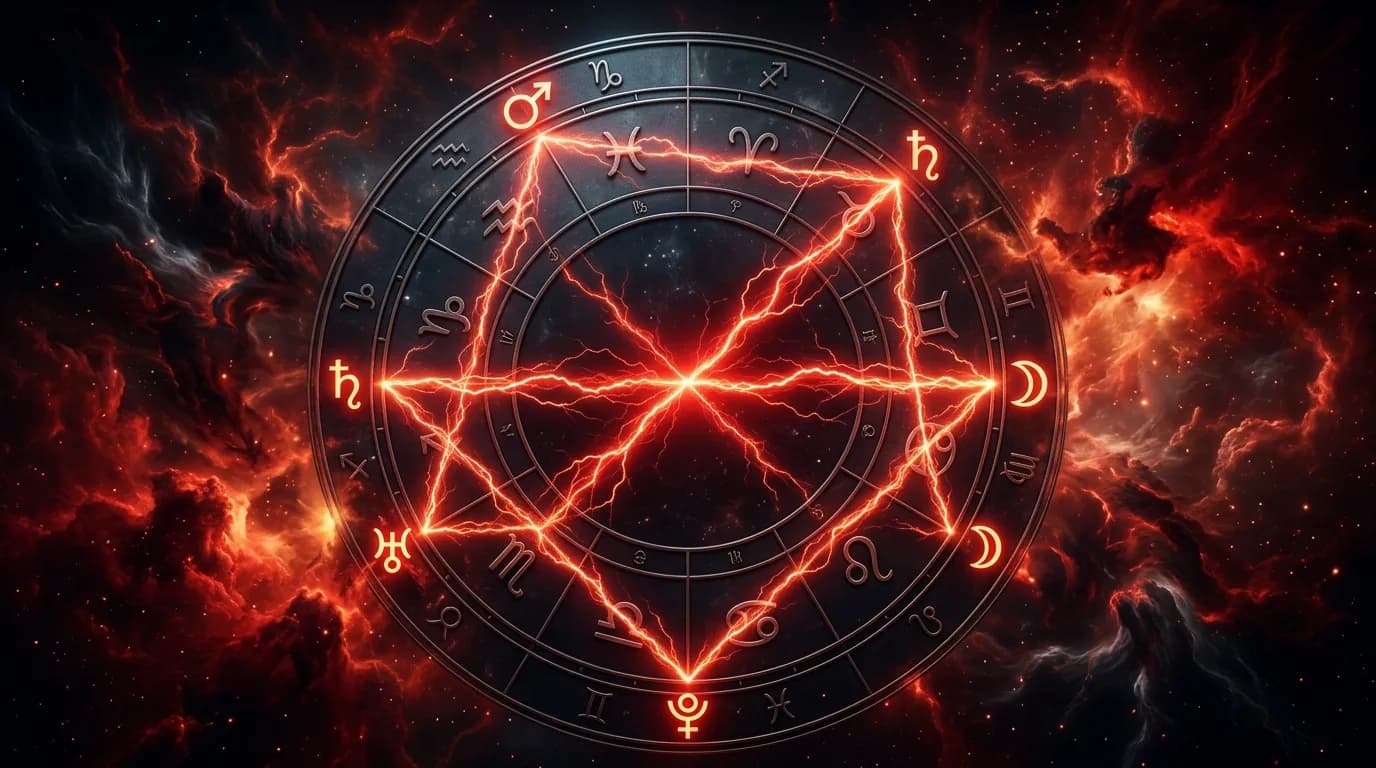
When a beginner draws their natal chart and sees many red lines crossing the circle, the first reaction is panic. "Everything is bad for me! My chart is afflicted!"
Build your natal chart
Discover the position of planets at the moment of your birth — the key to understanding your character and destiny
Build for freeCalm down. In professional astrology, there is no such thing as a "bad aspect." There are Harmonious aspects (green/black lines) — this is your comfort zone and laziness. And there are Tense aspects (red lines) — this is your "perpetual motion machine" and motivation.
Look at the charts of millionaires, Olympic champions, and presidents. They are almost entirely made up of red lines. Why? Because tension is what makes us get off the couch and act.
Table of Contents
- What is an Aspect: Geometry of the Soul
- Square (90°): Impact and Breakthrough
- Opposition (180°): Tug-of-War
- How to Work Through Tension: Examples
- Why Trines (Harmony) Are Sometimes Worse Than Squares
- FAQ
What is an Aspect: Geometry of the Soul
An aspect is a flow of energy between two planets. Imagine planets as people in a room.
- Conjunction (0°): They stand embracing and act as a single entity.
- Trine (120°) and Sextile (60°): They are friends, helping each other without being asked.
- Square (90°): They are rivals, elbowing each other.
- Opposition (180°): They are enemies, standing in opposite corners of the room and yelling at each other.
Square (90°): Impact and Breakthrough 🟥
The sharpest and most dynamic aspect. Symbol of Mars. Feeling: Itchiness, irritation, "a stone in your shoe." Something constantly bothers you, and to remove it, you need to make an effort.
- How it works: A Square creates a problem that cannot be ignored.
- Example: Venus-Saturn Square. A woman feels she is not beautiful or that no one loves her.
- Result: She begins to fanatically take care of herself, builds a career, earns money to prove to everyone (and herself) that she is the best. In the end, she becomes a successful businesswoman. Without this square, she would have just been a sweet girl.
Motto of the Square: "Through hardship to the stars."
Opposition (180°): Tug-of-War ↔️
Personal horoscope based on your chart
Register for free and get access to daily forecasts, numerology, and destiny matrix
Register for freeAn aspect of constant choice and fluctuation. Symbol of Libra. Feeling: You are torn in two. Either one or the other.
- How it works: Planets stand opposite each other. As soon as you pay attention to one, the other suffers.
- Example: Moon-Pluto Opposition. You want peace and comfort (Moon), but you are drawn to crises, extremes, and dramas (Pluto).
- Scenario: At home, you are "white and fluffy," but at work, you are a tyrant. Or vice versa.
- Result: The task of the opposition is to find balance. Not to choose "either-or," but to learn to combine. To build a "bridge."
Motto of the Opposition: "To have your cake and eat it too."
How to Work Through Tension: Examples
Working through (compensating) is the conscious redirection of "negative" energy into peaceful channels.
1. Mercury-Mars Square
- Problem: Causticity, arguments, rudeness, nervousness, hand injuries.
- Working through: Debates, public speaking (striking with words from the stage), energetic singing (rap), target shooting, working with sharp tools (surgery, carving).
2. Sun-Saturn Opposition
- Problem: Self-doubt, fear of father/boss, feeling that life is pressing down, spinal problems.
- Working through: Strict time management, career building, yoga (static poses), hardening, taking responsibility. "I am my own boss."
3. Venus-Jupiter Square
- Problem: Extravagance, laziness, gluttony, inflated expectations from partners ("I want a prince"), eternal dissatisfaction ("not enough gold!").
- Working through: Charity, collecting brands, working in the luxury services sector, studying foreign languages and cultures. Spend a lot, but on status items.
Why Trines (Harmony) Are Worse Than Squares
Harmonious aspects (Trines) are a talent given by God. Everything comes easily to you. What's the catch? You don't appreciate it. A person with "only trines" often lives a boring life. They don't need to fight; they are already comfortable. They lie on the couch and wait for a miracle.
But a person with Squares cannot lie down — the planets "bite" them. They are forced to move. Therefore, great success is always the result of tension.
FAQ
I have a "T-Square" in my chart. Is that scary?
A T-Square is a triangle formed by two squares and one opposition. It is a very powerful configuration. It makes a person "driven." The main thing is to find the apex of the triangle (the planet that is under all the pressure) and load it with as much work as possible.
Can I get rid of a square?
No, an aspect is permanent in the chart. But you can transform it from an "event-based negative" (injuries, losses) into a "psychological positive" (activity, achievements).
What if I don't have any tense aspects at all?
This is rare. Most likely, you are a very pleasant, kind, and harmonious person, but you need a partner who will "kick" you and motivate you to achieve things.
👉 Check your aspects and discover your growth points
What the Sources Say About Difficult Aspects
The usual advice about squares and oppositions is to soften them. The reference material in our library takes a different line — it treats a tense aspect as a fixed amount of energy whose direction, not whose existence, is what you can change.
The aspect is not the problem; the level of working it through is. One observation in the material is worth more than any list of interpretations: at a low level of development a person will lie clumsily or fall into false positions in the sphere of the planet involved — and it will seem to them inevitable, and sometimes even constructive. The example given is a semi-square between Jupiter and Neptune, which makes a person susceptible to flattery, and that same flattery becomes their principal weapon, frequently betraying them. The mechanism described is not moral weakness but a misidentification of one's own tool.
A sextile is not a free gift. The material is careful about the difference between a sextile and a trine. A Mercury sextile does not produce instant, effortless, superficial rational understanding of the planet's principle — that is what a trine does. What a sextile does is make the effort constructive: the person who applies some work reaches a level where their understanding no longer profanes the principle but gives it new direction. This is a distinction most popular writing flattens into "good aspect".
Conjunctions are the hardest to work through. Another observation notes that Mercury conjunct the Sun occurs very often, contains considerable potential, and is very rarely worked through — because human pride, both mental and volitional, gets in the way. The person forgets, or never knew, that both their thoughts and their inner strength come from God. The point generalises: the difficulty of an aspect is not proportional to how tense it is, and some of the easiest-looking configurations are the ones nobody bothers to develop.
Where the classical and modern readings meet. The material on compounded afflictions is technical and specific: it describes a typical configuration in which one of the sexual planets is afflicted by the other of opposite gender, with at least one of them in exile or fall — for example an exiled Moon or Venus afflicted by Mars or Saturn while connected to Uranus or Pluto. The older authors and the modern ones in this library converge on the same method here: identify the dignity first, then the aspect, and only then the meaning.
What the malefics do when they are strong. A rule quoted from Lilly is worth keeping because it inverts the usual expectation: if a malefic is strong in essential dignity, it behaves better — Lilly's image is of a noble soul who holds an enemy in his hands but has no wish to harm him. Strength, in other words, does not make Saturn or Mars more destructive; weakness does.
What a difficult aspect does in your chart depends on the planets involved, their dignity, and the houses they rule — not on the aspect name alone. That is what you read from your own natal chart.
